
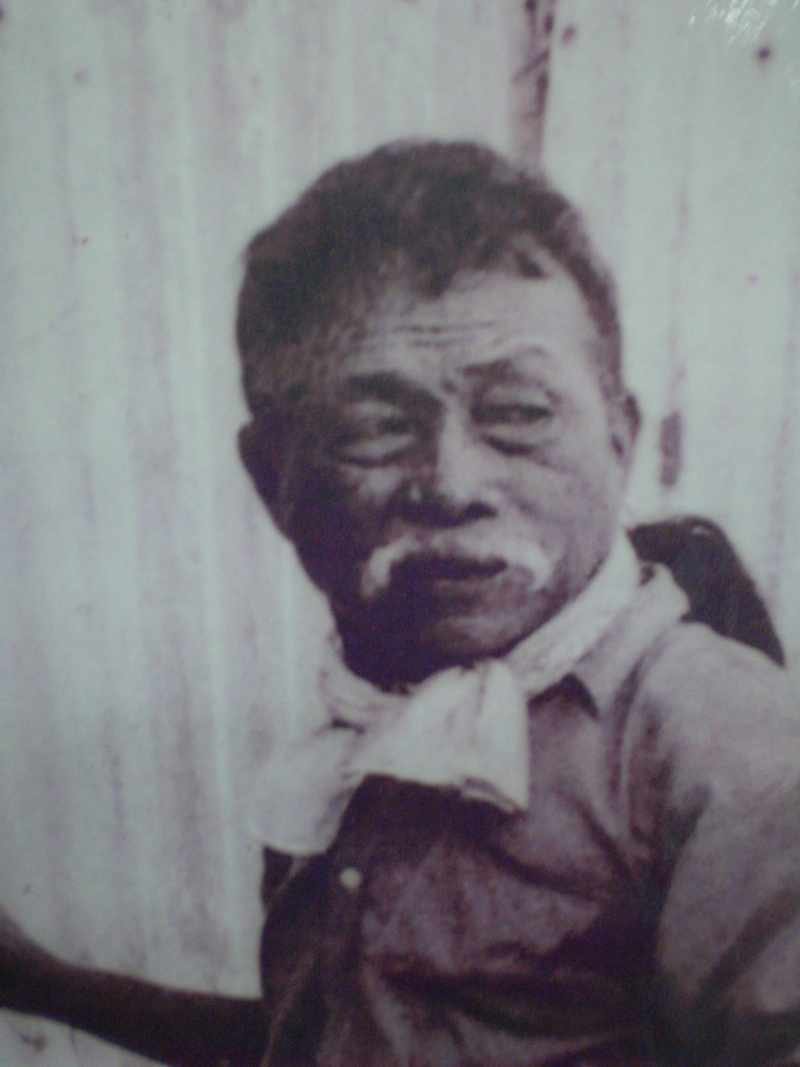
Sometime in the late 1800s to early 1900s, a man named Joseph Kanak, believed to be Jose/Joaquin Infaña Quinata, made his way to Australia. His descendants are reaching out to find out more about and to reconnect with their long-lost lineage from Guam.
Joseph Kanak was born sometime between 1866-1870, Guam and passed away May 3, 1939, Hammond Island, Australia, and is also buried there.
How did the surname Quinata evolve to Kanak?
The prevailing theory is that his surname Kanak evolved from the Quinata surname. Based on an Australia Death Index 1787-1985, Joseph Kanak is listed as the child of Waukin Leonardo A Kanak and Juliana Infana. If he is a Quinata, then in Guam his name would likely be recorded by the Spanish government as Jose Quinata y Infaña.
In one of Dr. Anna Shnukal’s papers, she mentions that Joseph Kanak was from Guam, living among a Filipino community on Darnley Island.
Some additional background…The Filipinos were initially brought in as pearl divers during a height of the Australian pearling industry in the late 19th century. In 1914, Kanak married Raphaela Garcia Francis, the daughter of a Filipino pearl diver. By 1929, the Kanaks were one of the first of two families to settle on Hammond Island, which was a settlement established by the government for Filipino-headed families.
Back to the surname…In 1891, there were five CHamoru men from Guam recorded as stowaways on the whaling ship Charles W. Morgan. One of them was Joaquin Gumata, single, age 19, whose parents were listed as Leonardo and Juliana. It is likely that the Gumata surname was a pronunciation issue or/and transcription error for the Quinata surname.
How did the first name Joaquin evolve to the name of Joseph?
Based on the historical crew listing of the whaling ship Charles W. Morgan, while there is no recording of a Quinata surname, there are, at least appears to be, three separate recordings of a Joaquin Kanaka recorded with spelling variations of his first and surname. Interestingly, the age did not change in the three recordings, which would question if in fact these were all the same individual:
- Joaquim Kanaka, age 22, Seaman, birthplace Guam, voyage period: November 24, 1891 to November 7, 1892.
- Joaquim Kanago, age 22, Seaman, birthplace Guam, voyage period: December 8, 1892 to November 9, 1893.
- Joaquim Karada, age 22, Seaman, birthplace Guam, voyage period: December 6, 1893 to November 15, 1895; noted as deserting at Auckland on February 17, 1894.
On February 17, 1894, the crew list notes that Joaquim Karada deserted the Morgan at Auckland on that date. Was this the impetus for Joaquin Kanaka to change his name to Joseph Kanak and list his father as Waukin (Joaquin) Leonardo A Kanak to avoid any penalty for desertion? Afterall, during this period, the ship’s Captain could impose harsh consequences on deserters such as forfeiture/deduction of pay, imprisonment or hard labor, or even forced return of deserter and face being handed over to local authorities.
When did he arrive in the Torres Strait islands?
The answer remains a research in progress.
From the Morgan, his last prior reported location was Auckland, New Zealand. But there seems to be conflicting information with the year he deserted the Morgan.
On December 6, 1893 the Morgan sailed on its 20th voyage. The master of the ship was J. A. M. Earle and the owner were Joseph & William R. Wing & Co. A summary for this sailing was reported as follows:
- 28 January 1894, at Ascension (Eastern Caroline Islands):
- 21 July 1894, at Hakodate [Japan]
- 23 October 1894, at Russell, New Zealand; 31 October, sailed
- 29 December 1894, at Auckland, New Zealand; sailed 22 February 1895
- July at Hakodate
- 05 November 1895, at San Francisco
If the Morgan sailed out of Auckland on February 22, 1895, Kanak may have deserted the ship on February 17, 1895, rather than in 1894 as recorded; perhaps a transcription error. All the sailing and arrival dates above suggest that he could not have deserted the ship on February 17, 1894.
It is believed that he may have arrived and spent some time in Western Australia before arriving in the Torres Straits. His first known location on Darnley Island was in 1904 for, purportedly, some type of policing activity. The type of policing activity is still being researched as well. 1904 was an interesting year, which included restrictions on Islander movement to and from the mainland.
Quinata Family
If all or most of these history clues are on point, then Joseph Kanak is the son of Leonardo San Nicolas Quinata and Juliana Quinene Infaña. Some members of the Quinata family have already reached out to the Kanak family to exchange family information and history.
DNA
The DNA connection to Guam exists. Some members of the Kanak family have had their autosomal DNA tested on Ancestry. From there, they have found their DNA ties to many CHamoru people on Guam, including a connection to my wife’s DNA!
If the Kanak family wishes to take a deeper DNA dive into their CHamoru Roots, the key to their paternal Kanak lineage lies within the Y-DNA test. This can help validate their paternal connection to the Quinata family. Only males carry the Y chromosome and therefore women cannot test for Y-DNA results, only the males.
DNA is the gateway and bridge to our native ancestors of Låguas and Gåni Islands (Mariana Islands)!
Bibliography
(name withheld). 2026. FaceBook messages exchange with Bernard Punzalan
Ancestry.com
Tyrone C. Deere. 1994. Stone on Stone.
Familysearch.org
Findagrave.com
Guam News Letter: August 1916. Deaths. Micronesia Area Research Center, Guam.
(name withheld). 2026. Email to CHamoru Roots, subject: Genealogical Inquiry: Infana/Leonardo/Kanak or Kanaka Lineage.
Mystic Seaport Museum. Charles W. Morgan Crew Lists.
Mystic Seaport Museum. Synopsis of the Voyages of the Charles W. Morgan.
Joaquin Vara de Rey. 1891. In Rodrigue Levesque. 2005. History of Micronesia, vol 33 page 80.
Dr. Anna Shnukal. 2009. Pre-war Filipino communities in Torres Strait.
Dr. Anna Shnukal. 2011. A double exile: Filipino settlers in the outer Torres Strait islands, 1870s–1940s. Aboriginal History, 35, 161–178.
Spanish Government. 1897. 1897 Census. Micronesia Area Research Center, Guam.
Jane Underwood. (undated). Genealogy Index Cards. Micronesia Area Research Center, Guam.